
How Do Content Clusters Help AI Understand Your Topical Authority?
Organize your pages into topical hierarchies that AI systems can interpret — pillar-cluster, hub-spoke, or silo models — each anchored to a central entity so search engines and AI assistants recognize your authority and cite you with confidence.
What Are Content Clusters?
Content Clusters let you organize generated and existing pages into a topical hierarchy that AI systems can interpret. Instead of a flat collection of unrelated articles, you build structured groups of content — each centered on a core entity — that demonstrate topical depth, reinforce authority signals, and give AI models clear evidence of your expertise.
Choose from three proven architectural models — pillar-cluster, hub-spoke, or silo — depending on your content goals, audience, and the depth of coverage you need. Each cluster is anchored to a central entity, creating a recognizable knowledge structure that search engines and AI assistants can traverse and cite.
- 3 cluster models — pillar-cluster, hub-spoke, silo
- Entity-anchored architecture for topical authority
- AI-readable structure that produces topical depth signals
- Flexible reorganization as your content strategy evolves
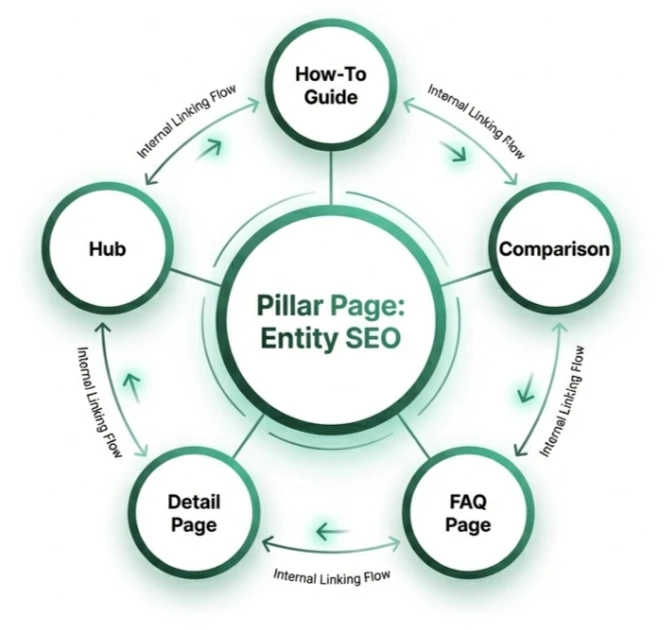
Three Architecture Models. One Goal: Depth.
Each cluster model organizes content differently to match your topical strategy. Choose the model that fits your content goals — or combine them across your site for maximum coverage.
Pillar-Cluster
One comprehensive pillar page supported by many detail pages that go deeper into individual subtopics. Best for deep topical coverage of a single entity where you want to demonstrate exhaustive expertise.
Central pillar radiates to detail pages
Hub-Spoke
Central hub page links outward to multiple spoke pages, each covering a different angle or subtopic. Best for broad topics with many related subtopics that each deserve their own dedicated page.
Hub connects outward to spoke pages
Silo
Strict category separation with no cross-links between silos. Each silo covers a distinct topic group independently. Best for niche sites requiring clean topical isolation to avoid diluting authority signals.
Parallel silos with no cross-links
AI Doesn't Just Read Pages. It Reads Structure.
AI systems don't evaluate individual pages in isolation. They interpret how information is grouped, related, and reinforced across your entire site. When your content structure is weak — even good pages feel isolated, disconnected, and unworthy of citation. Clusters make your topical depth visible so AI can see the full picture.
Topical Depth Signals
Clusters send clear signals that your site covers a topic comprehensively — not just superficially. This depth is what AI systems look for when selecting authoritative sources to cite.
Relationship Clarity
Clusters define how pages relate to one another through explicit hierarchy. AI models can traverse this structure to understand that your pages are part of a coherent knowledge system, not random articles.
Authority Reinforcement
Each page within a cluster reinforces the authority of every other page. Internal links carry context, topic relevance, and trust signals — compounding your authority across the entire cluster.
Clusters Work Best With the Full Suite
Content Clusters are the organizational backbone of your content architecture. They connect directly to three other Entify SEO features to create a complete end-to-end workflow.
Content Generator
Creates the pages that populate your clusters. Generate hub pages, pillar pages, detail articles, FAQs, and more — each pre-mapped with entity context and internal linking intent, ready to be organized into your chosen cluster model.
Learn about Content GeneratorInternal Link Builder
Strengthens connections within and between clusters. The Internal Link Builder identifies optimal linking opportunities across your cluster structure, reinforcing topical relationships and distributing authority where it matters most.
Learn about Internal LinksPage Builder
Lets you edit and publish clustered content. Use the Page Builder to refine generated pages, adjust headings, update answer blocks, and finalize content before publishing — all within the context of your cluster hierarchy.
Learn about Page BuilderFrequently Asked Questions
Common questions about Content Clusters and topical architecture.
Start Organizing Your Authority
Structure your content into pillar-cluster, hub-spoke, or silo architectures — each anchored to a central entity — so AI systems can interpret your topical depth and cite you as the authority.
Entity score improved by 34 points